Actors
The Best of John Ford’s Family of Players
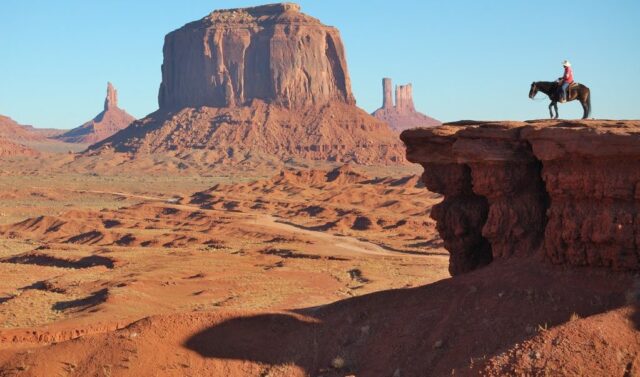
Over the years, some film directors have had their own so-called stock companies. We’re not talking Wall Street stocks, folks, but rather groups of actors they felt so comfortable working with that they cast them in their projects time and again.
The great John Ford’s stable of thespians was perhaps the biggest and most prolific in Hollywood history. In fact, some of its members appeared in the iconic director’s films over twenty times; bit player Jack Pennick worked with the filmmaker a whopping 41 times, although several of his roles were uncredited.
Of course, starting in the forties, John Wayne was Ford’s favorite star. “The Duke,” who also had an abiding off-screen friendship with “Pappy” Ford, could be seen in 24 Ford enterprises, all starring roles in some of Ford’s most iconic work (you can see some of these movie titles at the end of this article).

The Eagle Huntress
2016
Director(s):


Directors
Two Sides of the Camera: 8 Directors who Directed Themselves
Why, one has to ask, is it not pure megalomania whenever directors direct themselves? Simply put, this is a breed of actor (and director) who understands the vision so completely that the need to control every element, even their own performances, overrides all doubt.
Of course, this could look quite a lot like megalomania, or it could simply be pure genius. Or perhaps a bit of both.
For many auteurs, it feels perfectly natural. Orson Welles started out with the Big Bang of "Citizen Kane," his first feature film — with credits for directing, producing, co-writing, and starring — crafting what many critics agree is the best movie of all time.

Music
On Duke Ellington’s Birthday, The Five Best Jazz Movies
If you’re a fellow jazz lover, you probably look on Duke Ellington, born 115 years ago today, with awe. With a career spanning over half a century, Duke’s impact on jazz was incalculable. He not only played the piano with the deceptive ease and fluency Astaire brought to dancing, he led the best band in the business. He was a genius, and impossibly cool to boot. How so?
Beyond the music, Duke was elegance personified in a still highly segregated world. He was his generation’s Marvin Gaye, exuding a powerful sexual charisma that made him irresistible to women, regardless of race. His personal life was predictably chaotic as a result, but it seems as though everyone in Duke’s life understood: it was all about the music.
By the 1950s, his popularity was flagging a bit stateside. Most big band acts were folding, making way for “hipper” musicians like Miles Davis and Chet Baker. That all changed with his performance at the 1956 Newport Jazz Festival, when the Duke Ellington Orchestra caught fire and created something as close to perfection as you’re likely to hear. The lucky crowd was so enthralled that thousands of people “spontaneously started jitterbugging… hundreds of fans climbed on their seats [to cheer].” When their set ended, the crowd refused to disperse, screaming until Duke returned to the stage to placate the mob with more music. It’s a night that no one wanted to end.